





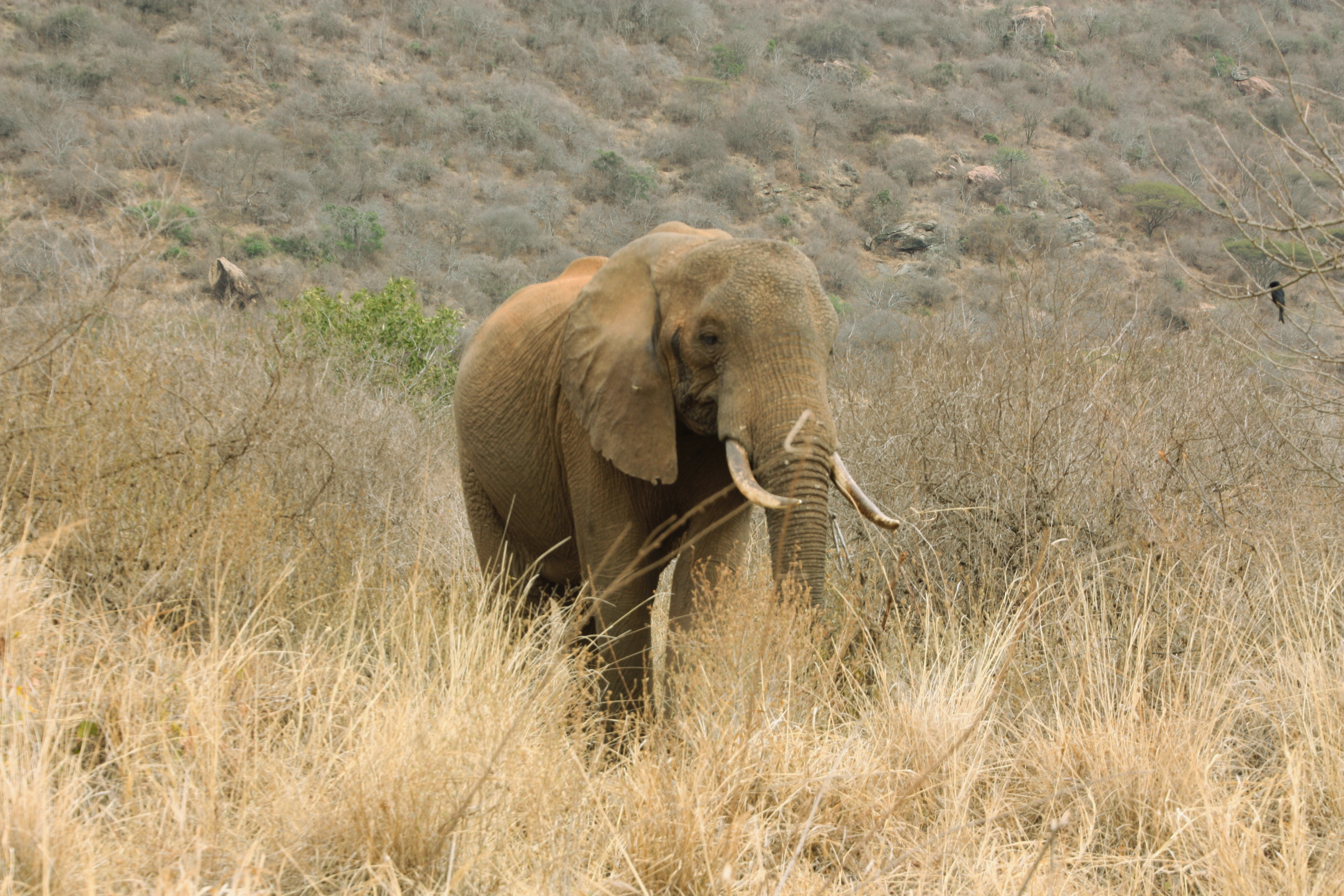
A wildlife camera takes a photograph of an elephant.
To us, the result is obvious. Large grey animal, trunk, enormous ears: elephant.
But the camera doesn’t see an elephant. It sees millions of pixel values.
Turning those pixels into the word elephant is the job of computer vision. Modern AI has
become remarkably good at this, but recognising wildlife under real field conditions is more
difficult than it may first appear.
Animals may be far away, partly hidden behind vegetation or photographed at night. Images
can be blurred. Several species can appear together. Sometimes only a small part of an animal
is visible.
And sometimes the animal is something the AI has never learned to recognise at all.

First, find the animal
Before trying to identify a species, Qulinda first needs to determine whether there are animals
in the image and where they are.
Our pipeline uses an animal detector based on MegaDetector, further adapted to the
environments where Qulinda operates. It draws a bounding box around each detected animal
so that subsequent analysis can concentrate on the relevant part of the image.
But even before that, we check image quality. A badly blurred photograph may simply not
contain enough information for reliable identification.
This is an important principle throughout the pipeline:
Good AI should know when the evidence is poor.
From animal to species
Once an animal has been detected, another model attempts to determine its species.
Training such models requires enormous numbers of examples. Qulinda’s models have been
trained using millions of wildlife images from different sources, including hundreds of
thousands of images collected through our own work in the field.
This matters because real wildlife-camera images look very different from perfect
photographs of animals on the Internet.
The system must learn elephants from above and behind, buffalo in darkness, partially hidden
animals and all the other imperfect images that cameras actually produce.
But even a good classifier can make surprising mistakes.
Does the answer make sense?
Suppose a photograph contains a herd of buffalo. The classifier identifies animal after animal
as buffalo – but decides that one in the middle of the herd is a lion.
It is possible.
But it is also a reason to be suspicious.
Qulinda can use the other animals in the scene as additional information. We call this a herd
prior. Classification is no longer based entirely on each animal in isolation; the context helps
us judge which answer is most plausible.
There is another source of information: time.
Wildlife cameras often take several photographs in rapid succession. If we can track the same
animal between images, we get several opportunities to classify it. Instead of trusting one
prediction, Qulinda can fuse the probabilities from multiple images to reach a more
reliable result.
Several imperfect observations can together provide strong evidence.
What if the AI doesn’t know?
There is an even harder problem.

Imagine that the camera photographs a species that wasn’t represented when the classifier was trained. A conventional classifier may still confidently select whichever known species happens to look most similar.
That can produce a very precise answer that is completely wrong.
Qulinda therefore includes an out-of-distribution model designed to detect cases where an
observation does not fit sufficiently well with the species the system knows.
In that situation, we would rather report:
Animal
than confidently report the wrong species.
Knowing when not to make a classification is an important part of making AI useful in the
real world.
From photographs to observations
The result of the Qulinda vision pipeline is not simply a label for an entire photograph.
Individual animals can be detected, located within the image and classified, each with its
associated evidence.
The original photographs are preserved, while the resulting information is stored and can be
processed together with time, location and other observations.
That changes what a wildlife camera can become.
Instead of asking someone to inspect thousands of photographs, the system can help answer
questions such as what species was observed, where and when?
A camera captures pixels.
AI turns those pixels into possible animals and species.
And a carefully designed pipeline decides when there is enough evidence to trust the
answer.
That final step may be the most important one.
Leave a Reply